As the dust settles on the eighth edition of the Lake Como Design Festival, ICON shares our favourite installations, the latest furniture launches, exhibitions to see and more

Photography by Silvia Rivoltella featuring Lobby Nomade
Words by Jessica-Christin Hametner
As the eighth edition of Como’s design festival draws to a close, the city is still alive with everyone from local families – dogs are very much welcome here – to designers who flock to Lombardy’s upscale city to make the most of the annual design festivities. From emerging creatives to know and buy, spectacular villas opening their doors to the public for the first time and studios worth seeking out, ICON rounds up the must-see highlights.
Established in 2018, Lake Como Design Festival has grown from a small fair at the Teatro Sociale into a city-wide event founded and artistically directed by Lorenzo Butti. Small enough to see it all, superbly curated and with plenty to discover, it continues to be a delight. This year’s theme, Confine (Border), has also pushed the festival beyond Como, extending its reach to the neighbouring city of Lecco.
‘The border is not a limit, but a positive opportunity for us,’ says Francesca Prandelli, Lake Como’s chief coordinator, on this year’s theme. ‘Locals can enter these locations too, which is very important for us, so they can see the artistic richness that we have in our territory.’

Photography courtesy of Abreham Brioschi, who returned to the festival for another year to show his Ukuli Chair, drawing inspiration from Ukuli Bula, the traditional Hamer rite of passage
Expect historic venues filled with contemporary design, Rationalist landmarks opened up to curious visitors, studios and archives rarely seen from the inside and installations scattered around the city, lake and beyond. There are exhibitions that encourage conversation and plenty of reasons to take the scenic route, from a lakeside villa to a tucked-away atelier or a sprawling university campus, which Prandelli says is key to attracting and sharing the festival with younger generations.
What makes Lake Como Design Festival a firm ICON favourite – besides the fact that rushing is never on the agenda – is its slow-mo style of design wandering. While many festivals often demand detailed itineraries and strict timekeeping, here you can follow your eye rather than the clock. Consider us very much on board with that.
1. Future in the Past at Villa del Grumello

Photography by Alessandro Ruffini featuring Fronzoni 64 Collection by AG Fronzoni and Cappellini
First tip: if you’re a newcomer, start at Villa del Grumello, the heart of the Lake Como Design Festival, and home to Wonderlake Como, the organisation that has run the festival since its inception eight years ago. There’s a strong selection here year after year – ICON has attended the festival religiously for the last three – and plenty to marvel at, both inside the villa and out in its picturesque park overlooking the lake.
This year, the presentations uncover never-realised prototypes, forgotten drawings, preliminary studies and research materials – all refreshing, inspiring and, frankly, brilliant to see, showing the human thinking and making behind design in our tech-driven world. A highlight is the archival work of AG Fronzoni, presented alongside his Fronzoni 64 Collection, published by Cappellini, which showcases the Italian graphic designer’s staunchly minimalist typography, a signature aesthetic that was equally evident in his monochromatic wardrobe.
Elsewhere, Nicolò Spinelli, with the curatorial direction of Elisa Ossino, presents his work with the Meda-based woodworking company Simonetto in Incontro, a playful exhibition that invites interaction. Samples, sketches and videos sit within a boiserie in shaded eucalyptus and a red palm console, creating a cabinet-of-curiosities-style installation, which encourages visitors to open little wooden doors and peek at the discoveries hidden behind them.

Photography by Alessandro Ruffini featuring Incontro by Nicolò Spinelli, Elisa Ossino and Simonetto
Other favourites include Disegno Nomade by artist Lupo Borgonovo, in collaboration with Lithos Edizioni, which transforms enlarged details of nomadic Eurasian buckles into contemplative drawings, alongside etchings tracing their marks and a handwoven jute rug by Jaipur Rugs depicting a heron with outstretched wings.
Plus, ETEL presents an exhibition dedicated to Lina Bo Bardi, in collaboration with Instituto Bardi, bringing historical photographs of Casa de Vidro, her 1951 home, into dialogue with SESC Pompéia, the public complex she developed between 1977 and 1982. Original furniture, reissued by ETEL and Marcenaria Baraúna, reveals how Bo Bardi applied the same considered approach to both her own home and public spaces, but also how she promoted and protected Brazilian culture and its people.

Photography by Alessandro Ruffini featuring Proporzione Mediterranea by Annarita Aversa of Architetti Artigiani Anonimi and curated by Giustini Stagetti Gallery
The thread continues with Proporzione Mediterranea, conceived by Annarita Aversa of Architetti Artigiani Anonimi and curated by Giustini Stagetti Gallery, which looks to the vaulted houses of the Amalfi Coast to explore architecture shaped by its landscape, climate and everyday life. It’s the result of a research project that explores the idea that architecture and design are, in essence, one and the same discipline.
The Carla Badiali Archive offers another glimpse into a designer’s way of thinking, with drawings from her collaborations with Hubert de Givenchy and Pierre Balmain, alongside explorations of printmaking and Eastern influences. Spanning twentieth-century Italy and Europe, it tells the story of Carla Badiali, known for pioneering the artistic avant-garde of the Como Group, while also bringing the same values and excellence into the world of textile production.
Then, out in the evocative Darsena of Villa del Grumello, Codiceicona presents a reissue of Luciano Baldessari’s Luminator Barcelona 1929, a sculptural lamp created almost a century ago for the International Exposition of Barcelona that still feels remarkably contemporary in its interplay of light, form and movement.
2. Nella Natura: Stories of Those Who Chose Another Life at Parco del Grumello
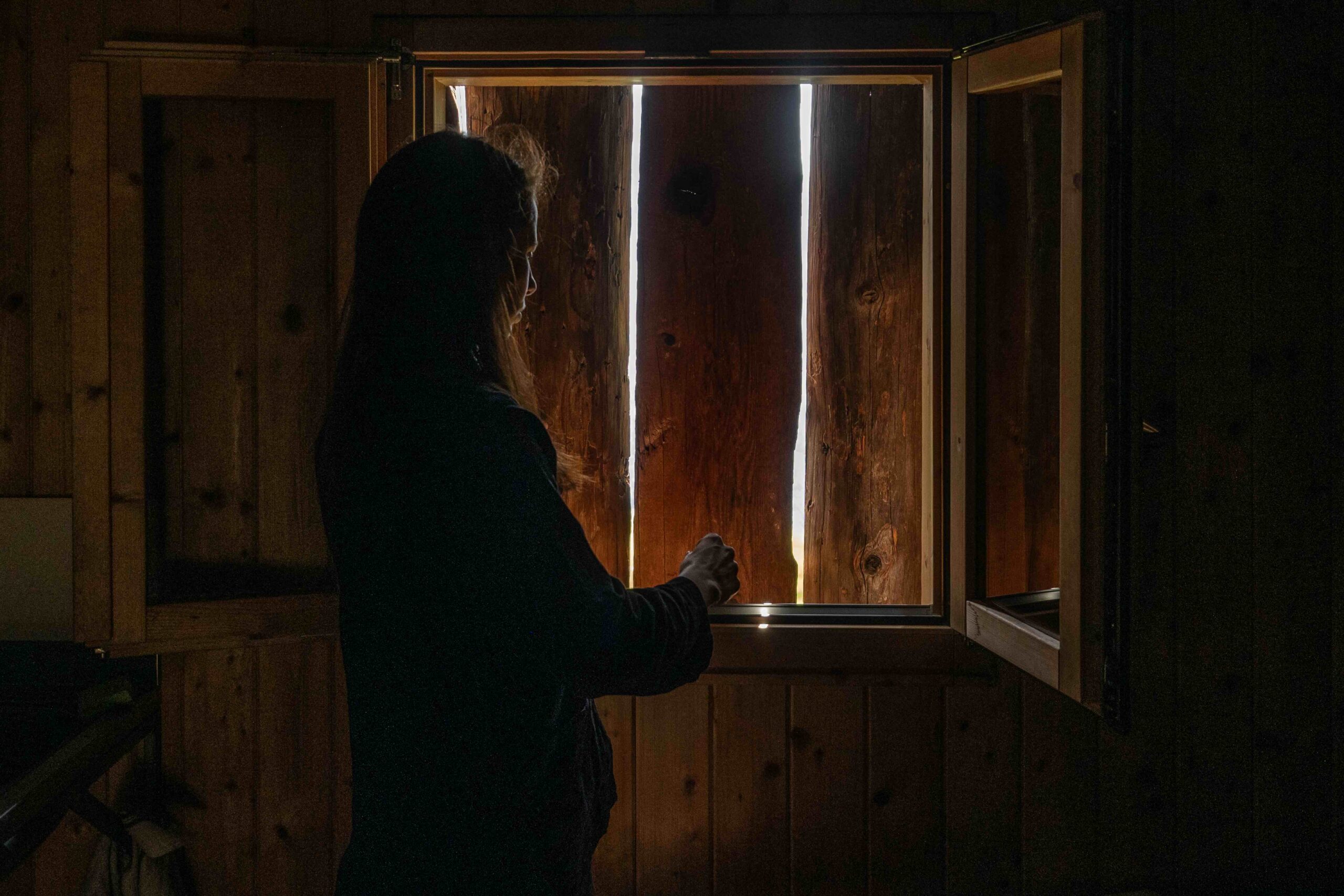
Photography by Selene Magnolia Gatti featuring Natalia Rogantini, as part of Nella Natura curated by Paola Manfredi
Found peeking through Parco del Grumello, just a few steps from the city centre and a short walk from the 17th-century villa, journalist Paola Manfredi has turned her eye to Nella Natura, an outdoor photographic installation that tells the stories of six people who “inhabit” the border between the city and nature.
‘We travelled throughout the Alps, visiting these six individuals and trying to understand how they live, why they choose to live there and how it’s possible to live in such remote locations,’ explains Paola Manfredi. ‘The idea of this project, which is not an exhibition but a story, is to tell other people that we can change. We can find a new way of living and it’s not so difficult. Everyone we spoke to was so welcoming, so gentle, and I guess living in nature is something that probably makes you a better person.’
Together with photographer Selene Magnolia Gatti, Manfredi travelled along some of the Alps’ lesser-known paths. Together, they met a musician living alone in an abandoned village in Val Chiavenna, a mountaineer and his wife in a forest at the foot of the Orobie Alps, a Zen monk who has turned an old stone house into a temple and others who have chosen lives connected to mountains, animals and the seasons.
It feels fitting, too, to experience these stories outdoors, following the photographs through the park rather than viewing them in a white-washed gallery. What’s more, the project is accompanied by an excellent bilingual book, in English and Italian, which visitors can pick up at the festival’s literary café-meets-bookshop and temporary bistrot, just a few steps from the installation.
3. Contemporary Design Selection at Villa Saporiti

Photography by Alessandro Ruffini featuring (from left) Marie Vilay, Studio Yellowdot, Minkyu Park, Studio von Schoenebeck and The Happy Few at Contemporary Design Selection
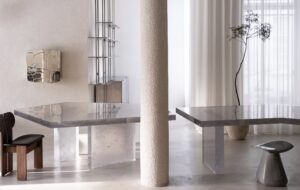
The buzz surrounding the festival’s Contemporary Design Selection is justified. A collection of quirky objets d’art and curious design pieces, many of which we haven’t seen anywhere else before (always a good sign), it takes over the breathtaking 18th-century neoclassical Villa Saporiti, with 57-plus projects unfurling across its many decadent rooms.
Curated for the fourth consecutive year by Giovanna Massoni and directed by Francesca Prandelli, chief coordinator of the festival, the selection features designers, artists, architects, craftspeople, collectives and galleries from more than 50 countries, all responding in their own way to this year’s theme.
The result is eclectic, with no neat categories or obvious hierarchy, and that is rather the point, according to Massoni and Prandelli, as they told ICON. Building on the success of previous editions, visitors wander from one object to the next, fashioned from a variety of materials, including ceramics, textiles and pieces made from waste and biomaterials.

Photography by Alessandro Ruffini featuring Claustra by What’s Wrong Duo at the Contemporary Design Selection
Among the participants are Abreham, Vittorio Di Girolamo and Xenia Kwiatkowska, alongside a long list of independent designers and emerging studios from across the globe. The works range from wonderfully playful to conceptual: Shanghai-based textile studio The Happy Few presents The Long Take, a vivid 10-metre-long piece inspired by irregular grids of sidewalk paving.
Elsewhere, Studio Pastina‘s, Soft Monuments reinterprets ancient Roman sculpture as soft, upholstered seating, wrapped in Groma, a 3D-knitted textile the studio designed for Dutch textile firm BYBORRE.
In typical Italian fashion, Tattile brings a whimsical touch. A curving daybed by Studio Yellowdot created for Barilla’s 3D-printed pasta brand Artisia, it is inspired by the looping form of a strand of spaghetti. Its sinuous silhouette features the studio’s signature joyous spirit and is designed to raise a smile (and it does).
Rounding out the selection is Marie Vilay‘s To Read a Pattern, a beautiful textile installation that reimagines traditional Laotian motifs through contemporary weaving techniques. Drawing on patterns gathered during field research in Laos, Vilay uses translucent textile banners to explore migration, cultural inheritance and how craft traditions are passed between generations.
4. Fine Comune by Nomade and Ultrapresent Studio

Photography by Alessandro Ruffini featuring Ultrapresent Studio, who creatively directed Fine Comune
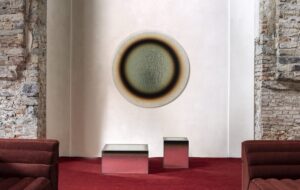
Those with a penchant for beautifully considered spaces should make a beeline for Fine Comune, Nomade’s exhibition in the former Church of Santa Caterina, built in 1634 on foundations dating back to the late 13th century. Returning to the same atmospheric setting as previous years, the new project is developed under the creative direction of Como-dwelling Ultrapresent Studio and takes its cue from the Latin con-finis (or, sharing a common border).
It is a fitting premise. The church’s traditionally sacred character is transformed into a place to meet and socialise, centred around a bold red carpet, offset by Acerbis‘s upholstered oxblood-coloured Free System sofa and handcrafted rugs that come courtesy of cc-tapis. The fiery red colour palette creates a dramatic contrast with the church’s delicately frescoed walls, while a stunning selection of collectible design adds further intrigue.

Photography by Alessandro Ruffini featuring Fine Comune
Behind the selection is Movimento Gallery, which has brought together work from designers and artists around the world. Look out for pieces by Swedish studio Elakform, set aside edgy seating by Seoul-based designer Atelier Sohn, while Costantino Gucci‘s meticulously made Oculus Celestia – which ICON first spotted in Tuscany last year – illuminates the interior.
Further inside, monochromatic works in concrete and metal by Italian artist Luca Monterastelli, presented by Galleria Lia Rumma, punctuate the small side aisle before the exhibition opens out beneath the vaulted arch. Outside, mirrored sofas introduce a sleek, contemporary twist that sits effortlessly next to the old church.
5. Atto Puro by Ultrapresent Studio at Conservatorio di Como

Photography by Alessandro Ruffini featuring Atto Puro
There is, admittedly, no shortage of immersive installations on the design calendar these days. But Atto Puro, another compelling project by Ultrapresent Studio, delivers on the brief. Set within the Conservatorio di Como, it pairs the Conservatory’s Electronic Music course with Cosmos, a sound system designed and produced in 2025 by Ultrapresent in collaboration with sound engineer Alessandro Buggio.
Originally created for a musical performance revisiting a work by Giusto Pio, produced by Franco Battiato in the late 1970s, its walnut-root and brass speakers now form the centrepiece of a new sonic experience. From 12 to 20 September, an original scenography transforms the Conservatorio’s Organ Hall, with Cosmos set against surfaces from Dresswall and Virginia Arlotto’s Terra Sole rug for Milan-based brand Malcusa. The music, developed by students on the Electronic Music course throughout the academic year, fills the room, creating a contemplative environment for daydreaming.
As final stops go, Atto Puro is a rather good one. In keeping with the theme, the line between sound, space and design becomes pleasingly blurred. Visitors sit and listen to the meditative soundscape, while the occasional interruption of children playing brings a welcome informality to the room. So impressive is the experience that people seem genuinely absorbed in the moment and, rather wonderfully, there isn’t a phone in sight.
Get a curated collection of design and architecture news in your inbox by signing up to our ICON Weekly newsletter