In Malmö, Jenny Nordberg creates limited-edition objects that sit between art and design. ICON visits her studio to explore how the city’s openness and creative freedom inspire her practice

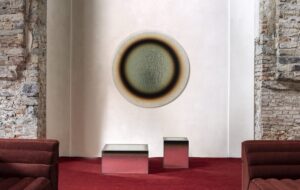
Photography by Form Design Center featuring Jenny Nordberg in her Malmö studio during Southern Sweden Design Days 2025
Words by Jessica-Christin Hametner
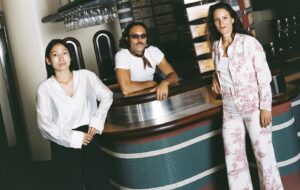
‘Moving freely and having fun are central to my practice’, says Jenny Nordberg, while settling into her new studio, a converted terraced house in Malmö she opened during Southern Sweden Design Days last year. The area has, in recent years, attracted a growing number of artists and designers drawn by space, affordability and the city’s creative freedom.
‘Running your own company is a lot of hard work,’ she adds. ‘So for me, it’s important to have fun.’ Nordberg laughs, describing how she once calculated that eight per cent of her time should be enjoyable. ‘Now I am sort of aiming for 100 per cent, but I still have to do the accounting too and that’s really not fun.’
That sense of autonomy extends beyond how Nordberg works to who she chooses to work with. Projects such as the 3D-printed Free Applications chair, developed with Finnish manufacturer Brightplus using renewable materials, or Possibilities at Moderna Museet in 2020, where new objects were made from discarded materials, reflect this approach. Collaboration, for Nordberg, is not about visibility.

Photography by Form Design Center featuring Jenny Nordberg in her Malmö studio during Southern Sweden Design Days 2025
Many of her works engage with waste not simply to optimise resources, but because a more heuristic, exploratory process brings her joy. ‘I like choosing who to work with,’ she notes. ‘It’s super important that it’s a real collaboration – that you actually collaborate on something mutual. So I allow myself to be pickier.’
Malmö, she admits, has played a larger role in shaping her practice and attitudes than she once realised. ‘I was going to say the city didn’t influence me at all,’ she says, before reconsidering. Earlier in her career, she produced work she believes wouldn’t have dared to make had she been based in Stockholm.
‘The works were maybe a bit too strange. You think, what would people say?’ In Malmö, she explains, those concerns fade. ‘No one cares and no one really knows about conceptual or contemporary design. And maybe that’s the best part here. You feel free.’

Photography by Form Design Center featuring Jenny Nordberg’s Pile chair
That freedom is evident throughout the city. There is a feeling of openness, a safe base for experimentation and even failure. ‘Maybe when you know people will judge you, you become scared to really share your work,’ she says. ‘Here, it feels easier to push boundaries and perhaps do something weird.’
Part of that comes down to scale. Malmö is smaller and less competitive than many capital cities. ‘You can go out on your own and always meet someone to talk to,’ she explains. Others describe it as a combination of size and location, an underdog position that allows for generosity rather than rivalry. Where creative scenes elsewhere can feel guarded, Malmö has become increasingly open.
Economics play a role too. ‘As in all countries, it’s super expensive to live in a capital city,’ she notes. ‘It’s less expensive to live here, so you can afford to be more radical. You can afford to be open with ideas and expressions in a way that maybe you can’t elsewhere.’

Photography by Form Design Center featuring Jenny Nordberg in her Malmö studio during Southern Sweden Design Days 2025
This environment has fostered initiatives that prioritise collaboration. What began in Skåne as a local exhibition in 2015, Den Nya Kartan (The New Map), bringing together 24 designers and 24 manufacturers, has now grown into a national network. Initially conceived to demonstrate the potential of local collaboration, the initiative has since evolved into SPOK, now spanning 12 regional hubs across Sweden.
Spearheaded by Nordberg in 2016, it exemplifies how Malmö’s design culture tends to grow outward rather than upward. By prioritising local over global manufacturing, SPOK seeks to strengthen geographically close production and consumption, contributing to a more sustainable, long-term relationship with the climate and environment.
Place also matters materially. Nordberg prefers to work with resources that are close at hand. ‘I find it strange to work with materials that aren’t here,’ she says. ‘It feels natural to work with what’s around you.’ There’s an activist instinct behind that choice too. ‘I can’t really see why I should cut down a tree in Siberia, ship it to Southeast Asia and then sell it here. There’s something wrong in that setup.’

Photography by Form Design Center featuring Jenny Nordberg’s studio
Working locally, she argues, is not only more responsible but also more efficient than it perhaps used to be. ‘It’s much faster nowadays and not much more expensive. There’s really no reason to be all over the planet.’
This grounded outlook sits at the heart of a practice that has gained wider recognition. In 2024, the studio received the Bruno Mathsson Prize alongside Fredrik Paulsen and Finn Ahlgren, marking a significant moment for a firm that has remained deliberately independent.
Together, the trio went on to set up the print publication, Jag hör inte (I Can’t Hear), a project centred on the importance of design criticism, or rather its absence. The question of how design is valued and evaluated continues to preoccupy her.

Photography by Form Design Center featuring Jenny Nordberg’s Open Infinity lamp
‘If there is no design critique, what does that do to society?’, she asks. ‘Design is everything we surround ourselves with. Everything we interact with is based on design. If design becomes a non-topic, what does that do to the scene, the business, everything?’
Malmö may lack major institutions – there are few museums dedicated to design – but that absence has given rise to something else. Temporary exhibitions, pop-ups and self-initiated projects appear across the city, often unannounced. ‘People just do things,’ she says. ‘If you feel like it, you do it. You join forces and make it happen.’
Back in the studio, that same attitude is visible. Curiosity serves as a springboard for Nordberg’s work, with many objects inviting intrigue and surprise in equal measure. Born from freedom and the space to have fun, this Malmö-based designer shows why adopting a more playful state might be exactly what 2026 calls for.
Get a curated collection of design and architecture news in your inbox by signing up to our ICON Weekly newsletter