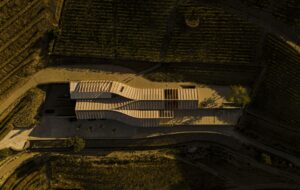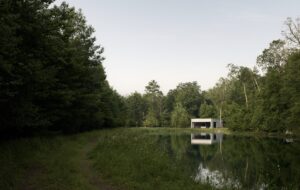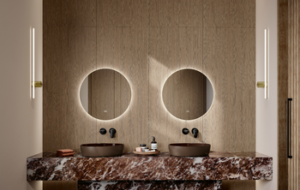
Since launching their eponymous design studio in 2023, Amandine Gini and Victor Moynier have worked on multiple projects exploring the ongoing dialogue between contemporary societal issues and cultural heritage. In an exclusive interview with ICON, they reveal the purpose behind their work

Photography by Mirjam Kluka, Victor Moynier and Amandine Gini, the creative duo behind Lausanne-based design practice Gini Moynier
Words by Roddy Clarke
‘We consider global economic, societal, and environmental dynamics as essential parameters that inform our design process,’ explains Amandine Gini, one half of the Lausanne-based design practice Gini Moynier. ‘Rather than treating them as constraints, we integrate them from the outset and allow them to shape our thinking and methodologies.’
Driven by a research-based methodology, the creative office spans multiple categories from product design to interiors and imagery. Already receiving an accolade of awards in their early years since launching the studio in 2023, such as prizes at the Dezeen Awards and from the London Design Museum, the duo is turning heads on the global design stage. Exhibiting at iconic venues such as the Victoria & Albert Museum, the Vitra Schaudepot and ProHelvetia’s House of Switzerland at Milan Design Week, coupled with a renowned client base from Nespresso to Bolia and Ligne Roset, it is the duo’s ability to address these global shifts through design that is resonating with a wide audience.

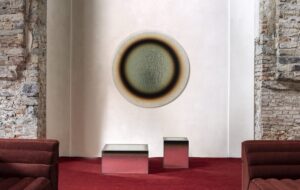
Photography by DSL Studio, Gini Moynier conceived the scenography at this year’s House of Switzerland at Milan Design Week, a project by the Swiss Arts Council Pro Helvetia and Presence Switzerland
‘The environmental dimension is the most immediate and pressing consideration within our practice,’ continues Victor when discussing the studio’s conscious approach to each project. ‘It informs every stage of our work, from material selection in the creation of an object or spatial intervention to the projected life cycle of the design, while trying to avoid compromising the desired level of quality.’ When designing products, the duo starts by gaining a deep understanding of the origin of raw materials, assessing its carbon footprint before evaluating its eventual recyclability. In leading with these mindful considerations and circular principles, they are helping brands, partners and clients to consider their environmental impact in a palpable way that will reshape the sector beyond the realm of just a singular project.

Courtest of Gini Moynier, ORTEGA by Gini Moynier
In leading with a belief that the responsibility of contemporary design is to acknowledge, understand and respond to global shifts, the studio’s work is a positive example of how design can meaningfully contribute to a healthier and more resilient society. The Offset Collection, for example, is a series of lamps manufactured from compostable air packaging used in the transport industry. Exhibited at Nov Gallery, the project has resulted in an inflatable light that can be easily shipped and fully disassembled. This responsible production and consumption approach also guides the studio’s scenography installations. As demonstrated in the House of Switzerland project, all the furniture and sets designed for the temporary showcase are now being used within a co-working space in Milan.

Photography by Cynthia Mai Ammann, FORMWORK is a series of furniture by Gini Moynier constructed from salvaged timber collected from local building sites
More recently, the duo has spent a month in Tajimi, Japan, collaborating with Tajimi Custom Tiles while immersing themselves in the region’s ceramic heritage. ‘We are now developing a collection with them scheduled for presentation in Tokyo in fall 2026,’ Amandine reveals. The studio will also be continuing its collaboration with the Swiss Arts Council, Pro Helvetia, developing the next chapter of its presence at Salone del Mobile in 2026. ‘The exhibition will focus on their core mission to connect the new generation of Swiss designers with industry players,’ she says, ‘while our direction is to look at design from a different perspective to highlight the research and vision behind each studio exhibiting.’

Photography by Wataru Fukaya, scenography conceived by Gini Moynier for ON RUNNING x SKY HIGH FARM
They will also be partnering with a UK-based music technology company in 2026 to create non-technological objects that enhance the rituals surrounding music listening. ‘It explores how sensory and experiential dimensions, diminished in recent years by the speed and prevalence of streaming, can be reintroduced to cultivate more intentional moments,’ Victor explains. ‘It is interesting to witness this cycle effect between innovation and heritage, and how past experiences keep feeding innovation to create new possibilities.’
With the duo passionately refining and expanding their design methodology, it will be exciting to witness their progress over the coming years as they continue to cultivate long-term collaborations. ‘Ultimately, our ambition is for the studio to be defined not by a stylistic signature, but by a consistent and thoughtful process, a distinct way of observing the world and formulating responses,’ they say. And, in a world that feels uncertain, it is a timely reminder of how such creativity can be harnessed as a tool for change, with critical dialogue leading to tangible results that foster connection and community at a time when we need it the most.
Get a curated collection of design and architecture news in your inbox by signing up to our ICON Weekly newsletter