
In contemporary design discourse, the most enduring objects are often those that resist immediate spectacle. As interior spaces become increasingly architectural in their thinking, the role of fittings has shifted from functional necessity to spatial punctuation – subtle yet decisive elements that contribute to the rhythm, clarity and material language of a room. With Vea, Villeroy & Boch explores this territory through a collection that privileges precision over expression, and permanence over effect.

Photography courtesy of Villeroy & Boch
Designed by Christian Haas, Vea draws from the visual discipline of classic modern interiors, where proportion, geometry and material honesty establish a quiet order. Rather than referencing nostalgia, the collection distils these principles into a contemporary design language conceived for longevity. Vea does not seek to stand apart from its surroundings, but to complete them.
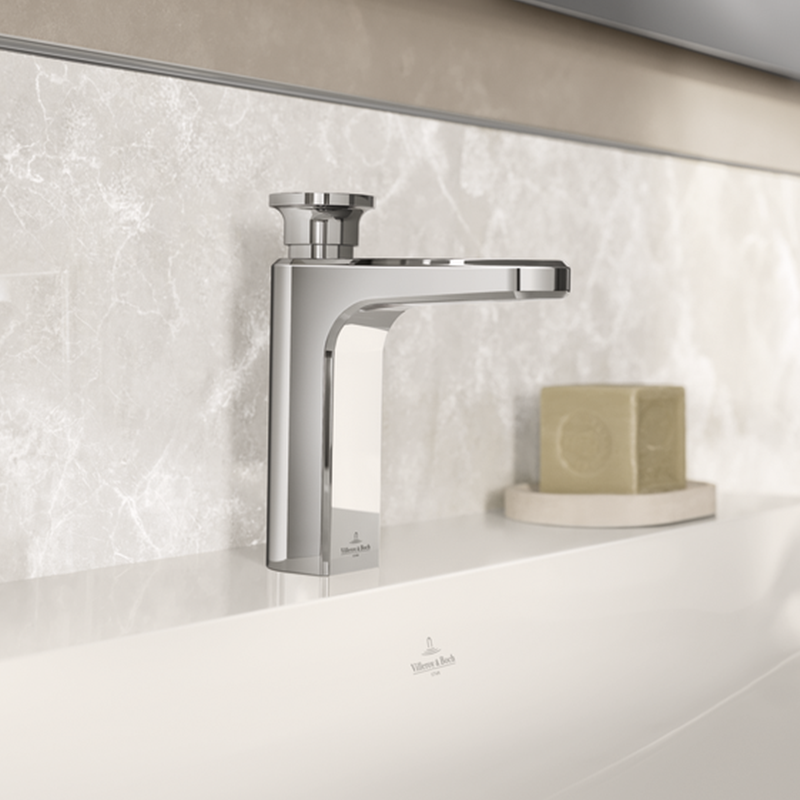
The defining gesture of the collection is the facet. Inspired by the clear geometry of traditional perfume bottles, these surfaces are not decorative articulation but structural definition. They shape the tap’s silhouette through controlled planes that catch and redirect light, producing a shifting interplay of reflection and shadow. The object becomes legible not through ornament, but through the precision of its edges and the clarity of its form.

Photography courtesy of Villeroy & Boch
This formal clarity extends into interaction through ViPush, a control system that replaces the conventional lever with a central press-and-turn mechanism. Water is activated by a single press, while temperature is adjusted through rotation. The gesture is compact, intuitive and intentionally tactile. Crucially, it allows the purity of the form to remain uninterrupted, integrating function into the centre of the design.
Material decisions reinforce this integration of form and function. Selected models feature a ceramic inlay embedded within the control knob, establishing a subtle material dialogue with the washbasin. This transition between ceramic and metal is not purely visual; it enhances tactility and reinforces the fitting’s role as part of a broader architectural composition. The collection is offered in chrome with a white ceramic inlay, matt black with a black ceramic inlay, or in full chrome, each variation shifting the tone of expression while preserving the same formal logic.

Photography courtesy of Villeroy & Boch
Manufactured in Germany, Vea is defined by technical precision and tightly controlled production processes. Minimal tolerances are essential to maintaining the integrity of its geometry, ensuring that the clarity of form can be both seen and felt.
Despite its formal discipline, Vea remains versatile in application. In chrome, the collection feels softer and more classic; in matt black, more architectural and contemporary. Across all variations, however, Vea maintains a consistent identity rooted in balance, clarity and timeless elegance.
Photography courtesy of Villeroy & Boch
Ultimately, Vea positions itself within a wider shift in design thinking: away from objects that dominate space, and towards those that refine it. It reflects an understanding that technological innovation need not be visible to be meaningful, and that true elegance often lies in precision, proportion and the disciplined reduction of form.
Discover more via the Villeroy & Boch website here.