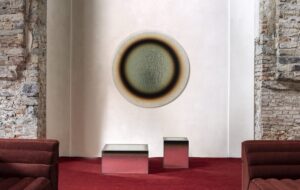
Set up by French architect Vincent Eschalier and designer Mattéo Lecuru in 2023, MVE-Collection is a design studio creating furniture from waste raw materials sourced from construction sites across France.

Photography by Jean-Paul Vaillancourt, A reception desk by MVE-Collection for Gustave Collection, constructed from repurposed concrete
Words by Roddy Clarke
With rising awareness around our environmental impact encouraging designers to prioritise natural or recycled materials, the challenge of maintaining a design-led aesthetic while addressing sustainability has been an area of navigation for many creatives. However, thanks to demand from an ever-growing base of conscious consumers and technical innovation, the results now being witnessed provide proof that such an approach certainly doesn’t mean a compromise on aesthetic. And, in the case of MVE-Collection, a young studio working with waste sourced from construction sites across France, it is leading to avant-garde collections that seamlessly blend function and form, each guided by the raw material it is made from.

Photography courtesy of MVE-Collection, Recycled aluminium vases by MVE-Collection
Founded in 2023 by French architect Vincent Eschalier and designer Mattéo Lecuru, who had previously been working together for eight years at Vincent’s architectural studio, MVE-Collection emerged as a natural extension of their practice: ‘A quest for balance between architectural rigor and tactile sensitivity, and between creative gesture and exceptional craftsmanship,’ they state. Now, two years on from its launch, the duo has conceived three collections crafted from materials such as aluminium, bricks and concrete.
Through their architectural projects and presence on construction sites, it sparked their ambition to work directly with materials being disposed of. ‘We became attentive to the materials we were demolishing or uncovering during the clearing phase of each project,’ says Eschalier, ‘from aluminium window frames to the brick hidden behind plaster or stone rubble from old floors.’ The duo’s initial project began with door handles for a commercial office project through which they recovered the aluminium from the site itself and transformed it into custom handles for that very building.

Courtesy of MVE-Collection, Tables crafted from recycled aluminium and repurposed bricks by MVE-Collection
Collaborating with artisans in the Île-de-France region, the studio is going from strength-to-strength. ‘The idea is to recover as much material as possible from a building and reintegrate it, in the form of furniture, back into that same space,’ Lecuru explains. ‘It also highlights, through material, the identity and history of a place, while giving the furniture and its environment a distinctive character.’
With aluminium window frames being melted down into ingots, bricks cleaned and reassembled into benches and tables, rubble mixed into concrete for reception desks and coffee tables, the duo’s ingenuity was showcased at Paris Design Week 2025, the studio’s first public exhibition. ‘Material lies at the very heart of our aesthetic,’ Lecuru continues. ‘Once recovered, we strive to understand its nature, its strengths and limits. Aluminium, for instance, melts at a relatively low temperature compared to other metals and can be recycled endlessly without any loss in quality. Using cast-iron molds for larger runs or sand molds for limited editions, we’ve developed surface texturing techniques that create random finishes, making each piece truly unique.’

Photography by Jean-Paul Vaillancourt, MVE-Collection are transforming discarded materials into design-led contemporary objects and furniture
Looking ahead the designers hope to develop further collections through the architectural projects they embark on. ‘We have the privilege of being involved from the earliest stages of a project, which allows us to identify suitable materials that align with our philosophy,’ Eschalier comments. ‘We also work closely with engineering offices, consultants, and fit-out specialists, all essential for understanding project requirements, regulations and certifications. These collaborations strengthen our collections and fuel our ambition to offer clients unique pieces imbued with history and craftsmanship.’

Photography by Jean-Pierre Vaillancourt, A sleek, contemporary table lamp by MVE-Collection, crafted from recycled aluminium
While this approach is another example of how circularity can be embedded into a project from the outset, it also pays homage to the duo’s commitment to sustainability. ‘We prefer to speak of environmental intelligence,’ they say. ‘It is often logical, and surprisingly simple, to recover and give new life to existing materials, sometimes nearly a century old. For us, design is secondary. What truly matters is celebrating the raw material and highlighting the craftsmanship that transforms it.’
Get a curated collection of design and architecture news in your inbox by signing up to our ICON Weekly newsletter