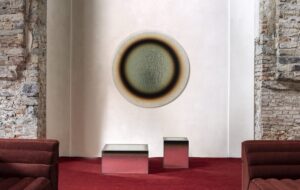
In his first-ever solo exhibition, held at the Museum für Gestaltung Zürich, textile designer Christoph Hefti invites viewers into his creative process and the imaginative worlds woven into each of his creations

Photography courtesy of Museum für Gestaltung Zürich, The Missing Cat and Other Textile Stories is the first solo exhibition for Swiss textile designer Christoph Hefti and it is currently on display at the Museum für Gestaltung Zürich until 3rd January 2027
Words by Roddy Clarke
‘I want people to walk off thinking, what was that?’, laughs Christoph Hefti, the Swiss textile designer and artist whose first solo exhibition, The Missing Cat and Other Textile Stories, is currently on display at the Museum für Gestaltung Zürich. With his whimsical creations filled with narrative and fantasy, he hopes viewers get a glimpse into his creative imagination while offering them the chance to expand their own creative minds. ‘I want them free thinking, to feel playful and to embrace the oddness,’ he says. ‘I want them to feel that there was something they couldn’t see but they could feel. I basically want them to be asking, was there a missing cat?’

Photography © Gregory Georgescu, Christoph Hefti (pictured here) creates thought-provoking dreamlike worlds through the medium of textiles
After working for two decades in the fashion world for notable houses such as Dries Van Noten, Balenciaga, Lanvin and Acne Studios, Hefti set out on his own creative journey in 2015, launching his eponymous studio dedicated to hand-knotted carpets, textiles, and ceramics. His carpets, however, have become a distinct medium through which the artist draws us into surreal worlds filled with animal-like creatures, masks and alluring dreamscapes. With each piece the starting point is a story. A story which then comes to life through Hefti’s inspired use of colour, materiality and craft. Deeply layered and three-dimensional, each rug becomes a striking statement leaving you wanting to know more about the world inside.
Witnessing his work collectively for the first time offers a rare chance to step fully into Hefti’s visionary imagination. Tracing the process from freehand sketches to finished pieces, the showcase also follows the journey to Nepal, where each rug is hand-knotted on vertical looms by a community of artisans working with traditional Tibetan techniques. ‘In this context, the museum, I find it important to involve the making process, it’s not really clarifying but rather creating an extra level of how to look at the rugs,’ he states.

Photography courtesy of Museum für Gestaltung Zürich, The exhibition takes visitors on a journey from initial freehand sketches to finished pieces allowing them to become immersed in the making of his dynamic carpets
The museum also commissioned Hefti to create a movie about his creative collaboration in Nepal. Created in partnership with a young collective (The Heruka Collective) in Kathmandu, the film showcases an honest insight into the making process. ‘It shows many aspects from the process but leaves many questions that are rather stimulating than resolving,’ he explains. ‘That’s how I want the audience to look at my film and my work.’
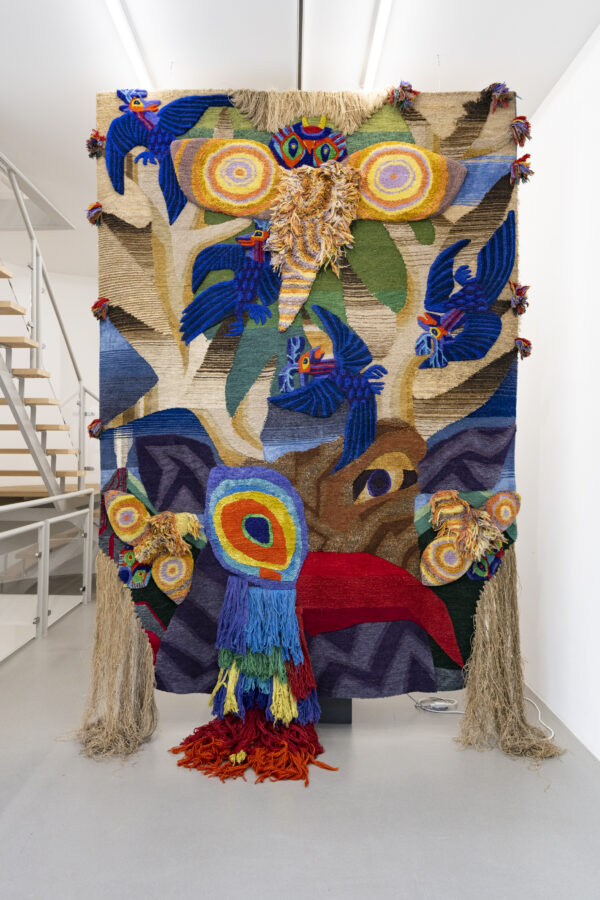
Photography © Sebastian Schaub, Each piece begins with a story rather than an image, which is then brought to life through silk, wool and long yarn structures that result in captivating statements of creativity
Each piece is a world in itself, and creating a set to match the energy they exude is an art of its own. ‘I generally try to create an atmospheric room that refers in an abstract way to an interior setting,’ he says. ‘Though they carry multi-layered messages that come together intuitively, I still try to imagine some kind of living scenario.’ For this exhibition, Hefti worked alongside the museum’s curator, Nora Wüthrich, to create a set that enhanced the mood he wanted to convey while respecting the context of the space as a museum exhibition.
For Nora, she says an important aspect of the process was working with a physical architectural model of the exhibition space. ‘We placed all the works in the model to scale, continuously rearranged them and explored and discussed a great number of combinations,’ she reveals. ‘This allowed us to translate the conceptual ideas into a spatial context and immediately assess how the exhibition chapters evolved, how the individual works interacted with one another in the space, where open and dense zones were needed and how visitors would move through the exhibition.’

Photography courtesy of Museum für Gestaltung Zürich, Hefti hopes the exhibition leaves visitors with questions rather than answers and, in response to its title, wondering if there is a missing cat after all?
Resulting in an immersive journey through Hefti’s universe, the show runs until 3rd January 2027. For the museum, his work resonates deeply with its longstanding commitment to textiles. ‘As a graduate of the Textile Class at Zurich University of the Arts he stands within a lineage that we have supported for generations. Artists including Sheila Hicks, Claire Zeisler and Lenore Tawney all had their first museum exhibitions in Europe at our museum in 1964,’ says Christian Brändle, the museum’s Director. Reflecting on Hefti’s work in the context of Swiss design, Brändle points to the breadth of the country’s contemporary design scene, moving as it does between pragmatism, functionality, and playfulness and humour. ‘Swiss creativity has never been defined by single approach,’ he concludes. And, it is the same balance, of artistry and storytelling, that Hefti’s work embodies, remaining a benchmark for designers the world over.
Get a curated collection of design and architecture news in your inbox by signing up to our ICON Weekly newsletter